

I (Sasha) am once again grateful to Damian for lending me this opportunity to give the people what they want: 4000 words on how to vote.
Despite/because of the efforts of many, we are once again voting in the Year of Our Lord 2026. California primary election ballots are mailing out, and are due back by Election Day on June 2nd. Note that because of… changes to postal service policy, you should plan to do one of the following:
- Cast your vote by mail at least a few days in advance of Election Day (June 2nd)
- Bring your vote-by-mail ballot to a dedicated ballot drop box
- Vote in person1 on or before Election Day (June 2nd)
Note that if you’ve recently moved to San Francisco, you can register to vote until May 18th and get a mail ballot, and after that you can still register in person and vote on or before Election Day on June 2nd. It’s easy, go do it!
One last bit of logistics: If (as I have already assumed) you live in San Francisco, you will be voting on 4 local measures and:
- 1 US Congressional Representative [primary]
- 1 School Board candidate [special]
- 1 of 2 different State Assembly members2 [primary]
- 1 local judge
- Possibly 1 of 2 different Supervisors [special]
What’s a Supervisor, and why am I voting/not voting on them?
“Supervisors” are the County government under California law – every county in the state has a Board of Supervisors who handle the responsibilities of the county – a court system and prosecutors, public health, and tax collection. Individual cities have city councils, who handle city responsibilities – usually other services like fire and police departments. San Francisco has a special government, unique in California, that consolidates both city and county and makes the Supervisors responsible for both. People who don’t want to pay taxes like whining that San Francisco has the largest city budget in California, and it’s because we have more legal responsibilities than any other city – the “city” is also the county.
You will only get to vote on one of these Supervisors in June (see below) if you live in their district (check your district here).
What does [primary] mean?
California utilizes a “jungle primary” system where the two best-performing candidates in June, regardless of party, face off on the ballot in November. Only state and federal elections have primaries.
What does [special] mean?
The Supervisors for District 2 (Marina/Pac Heights) and District 4 (Sunset) and one seat on the school board were appointed by the mayor to fill vacancies. Under state law, appointed candidates have to go on the ballot at the first opportunity, to decide if they can serve the remainder of the term they were appointed into. This creates the dumb situation where all three of these candidates will be on the ballot to decide if they can serve for the next 6 months.3 This vote is technically not a primary, but the candidates will be up for election again in November, and whoever is in the seat at that time will have an advantage when competing for a full four-year term. All of the even numbered Supervisor districts (2, 4, 6, 8, 10) and three seats on the school board will be on the ballot in November.
While the school board is citywide, you will only get to vote on one of these Supervisors in June if you live in their district (check your district here).
If you live anywhere in California, you will also be voting in the primary election for several statewide offices, most importantly the Governor.
Below is the scientific consensus on how to vote correctly in the 2026 June Primary. Each item in the tables links to a blurb that explains it in a little* more detail.
San Francisco
| Office | Guidance |
|---|---|
| US Congress, D11 | Saikat Chakrabarti |
| School Board | Virginia Cheung |
| CA Assm, D17 | Write in: Bradley Wiedmaier |
| CA Assm, D19 | Catherine Stefani |
| Sup. Court Judge #16 | Alexandra Pray |
| Supervisor, D2 | Stephen Sherrill |
| Supervisor, D4 | #1 Jeremy Greco, #2 Natalie Gee, #3 Alan Wong |
California
| Office | Guidance |
|---|---|
| Governor | Tom Steyer |
| Lt. Governor | Michael Tubbs |
| Secretary of State | Shirley Weber |
| Controller | Meghann Adams |
| Treasurer | Anna Caballero |
| Attorney General | Rob Bonta |
| Insurance Commissioner | Ben Allen |
| Superintendent of Public Instruction | Al Muratsuchi |
| Board of Equalization, D2 | John Pimentel |
There are no statewide ballot measures at the primary election; they’re mercifully illegal
Detailed Explanations
These are sorted by SF/CA, then by office/proposition, with a short blurb for each and a longer blurb on request if there’s anything interesting to say.
Unless otherwise noted, everything on your ballot is single-choice. The Mayor (not on the ballot) and Board of Supervisors (very limitedly on the ballot) are the only ranked choice elections – everything else is single-choice.
San Francisco
US Congress – Saikat Chakrabarti
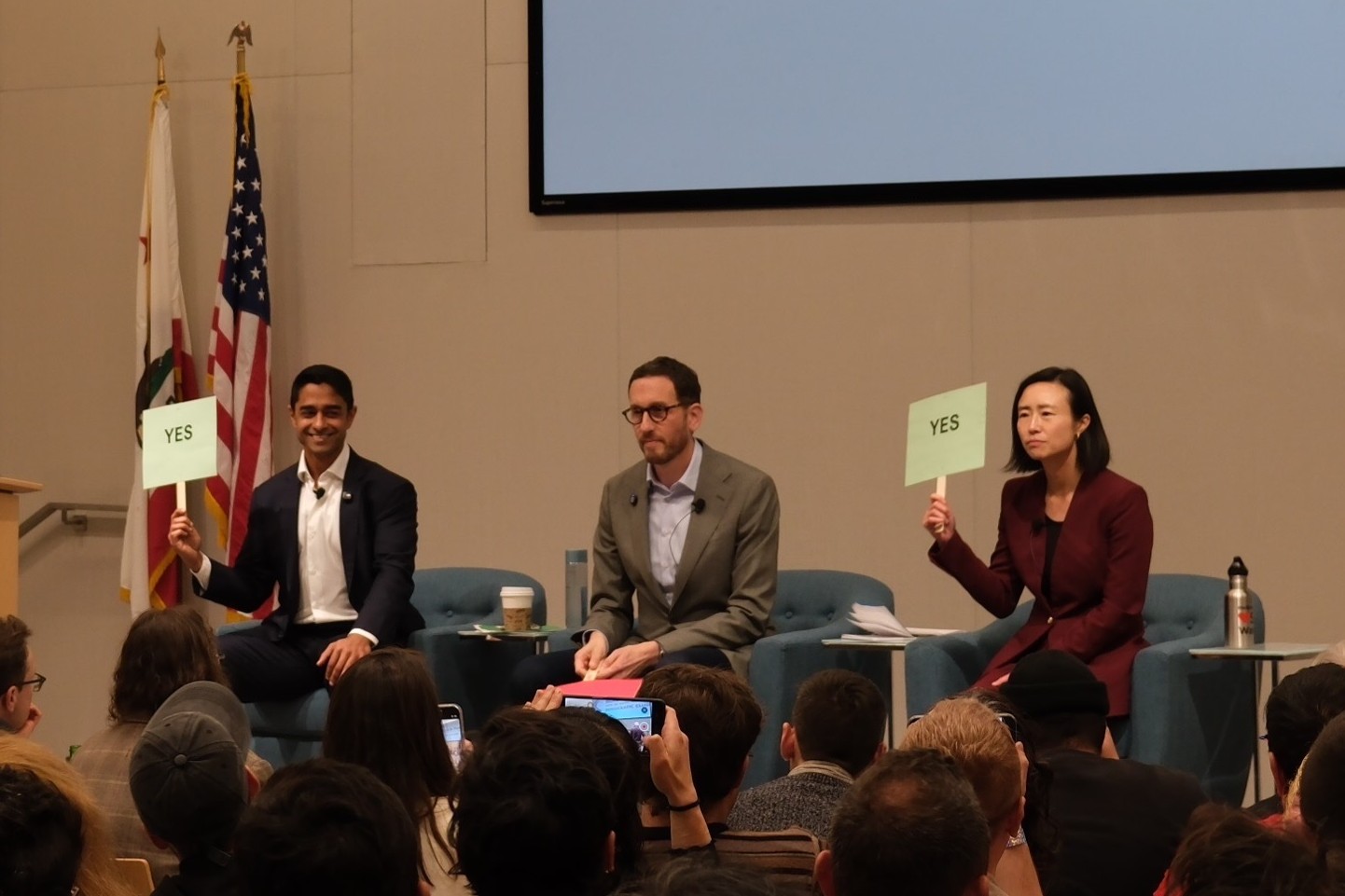
This is the first time there has been a competitive election for Congress in San Francisco in 40 years, and it’s a three-way race. Saikat’s two opponents, Connie Chan and Scott Wiener, are local elected officials with deep roots with San Francisco’s two current political machines. This election is an opportunity to vote for change, and replacing Nancy Pelosi with a political outsider (with good ideas and charisma) would be quite a change. [back to top]
Longer Story
I am on record as saying “I like Saikat, but there’s no way he makes it out of the primary.” Current polling suggests I am likely very wrong.
Saikat made an astonishing, life-changing amount of money working for Stripe, a software company, and instead of decamping to a beach somewhere he decided to sign up for a very painful job, working for the 2016 Bernie Sanders campaign. Two years later he signed up for a worse job, working for a campaign to unseat an entrenched congressional incumbent in New York who’d held his seat for two decades. That worked; that’s how we got Congresswoman Alexandria Ocasio-Cortez. Much hay has been made about his short tenure as her chief of staff (he left after 8 months); my counterpoint is that being a congressional staffer is quite different than working for a campaign (or, for that matter, being a representative) and results in one do not predict success in the other. Opting into three thankless jobs in a row – especially when you have enough money to replace every person in your life with a mindless suck-up – is, I think, a profound demonstration of character.
Saikat’s opponents – Supervisor Connie Chan and State Senator Scott Wiener – are both term limited out of their current jobs and interested in career progression. Nancy Pelosi’s forty years in Congress make it clear that this seat can be a very long-term job. Both have, I think, disqualifications to serve in Washington – Scott’s foreign policy positions (sustained hair-splitting on Israel that ended in a sudden shock of clarity in response to polls4) and Chan’s continuous misunderstanding of what Congress actually does (proposing to “expand sanctuary city protections across the nation,” ignoring the fact that Congress does not write sanctuary city rules, they make the [currently broken] immigration laws that sanctuary cities are opposed to). Both Scott and Chan are also clear attempts by San Francisco’s two local politics blocs – the both inaccurately named “moderates” and “progressives” – to get a loyal candidate into Congress to control the large spigot of federal money and thus gain an edge in local politicking.
I have no reason to doubt Saikat’s sincerity – again, this is a man who has enough money that he could never have to see any of us. Damian and I have both met him and shaken his hand more than once. If it turns out he wins and it was all a long con, I am very sorry, and you will be right to be mad at me if I convinced you he was genuine.
Saikat is a man who – it was reported shortly before I wrote this – tried to get AOC to debate civil rights legend John Lewis on the floor of the House because Lewis was selling out taxpayers to benefit TurboTax. There is no universe in which this is a good idea if you want a long career in politics; it only makes sense if you actually want to put $100 back in every American’s pockets every April. That’s on the small end of the things he’s proposed doing. People love Nancy Pelosi’s stunts to visibly oppose Trump – and don’t get me wrong, so do I. But let’s elect someone who is actually so motivated to speak truth to power and deliver for their fellow Americans that they’ll hurt themselves trying.
Full Disclosure: After the voter guide was released Damian has been volunteering with the Saikat campaign.
School Board – Virginia Cheung
The school board race is a three-way fight between the incumbent (appointed by the mayor) and two public school parents involved in parents’ group organizing. Honestly, all of the school board candidates’ websites are pretty thin, but Virginia has the best combination of stated goals (improving attendance, enrollment, and finances) with measures to do so (offering competitive programs, improving the predictability of the school lottery,5 and more). She is also endorsed by the local teachers’ union. [back to top]
CA Assm, D17 – Abstain* Write in: Bradley Wiedmaier
Matt Haney is running unopposed, which is pretty sad given that his priorities in Sacramento are niche legislation and spending money on 49er’s tickets. No rubber stamps to keep the seat warm. Write-in candidates in California have to be “qualified” via a signature gathering process and so it’s challenging even to mount a write-in campaign; however if it is not yet May 19th and you would like to file as a write-in candidate, let me know and you will have my help and endorsement. Bradley Wiedmaier is running on the Peace and Freedom ticket and is worth voting for to keep the write-in Republican from the ballot. [back to top]
CA Assm, D19 – Catherine Stefani
Asm. Stefani has plausible Republican opposition, and does not have any sports-related scandals. You can toss her a vote. [back to top]
Superior Court Judge #16 – Alexandra Pray
Pray is a public defender, running against an assistant district attorney. Research shows that former public defenders give fairer and more proportionate sentences as judges, having far more experience treating accused and convicted criminals as people than their counterparts. [back to top]
Supervisor, D2 – Stephen Sherrill
Sup. Sherrill was appointed by London Breed on her way out as mayor6. This is why he’s an above-average D2 Supervisor, contrasted against stealth Republican and corruption enjoyer7 Mark Farrell, mob lawyer nepo baby Michela Alioto-Pier, and a guy named Gavin Newsom. Sherrill’s opponent is a return to this proud tradition, a proud neighborhood busybody whose stated priority is to add red tape to city planning. [back to top]
Supervisor, D4 – Ranked Choice!
#1 Jeremy Greco, #2 Natalie Gee, #3 Alan Wong
D4 is currently represented by Sup. Alan Wong, who Daniel Lurie appointed to replace Sup. Beya Alcaraz after she resigned from a decade of honorable service.8 There are five competitive candidates in D4; the longshot amongst them is Jeremy Greco, who’s outspoken about his positive, welcoming vision for the Sunset. Because the election is ranked choice, you should rank him first, with one or more backups. Natalie Gee has been an unexpectedly strong supporter of the campaign to stabilize and grow Muni service. Alan Wong has been an ostensible supporter of housing construction across the city and in the Westside specifically. Both have… dubious politics on the other’s pet issue. Transit is in more active need of help right now, but Wong is preferable to the rest of the ghouls running in this district, hence the above 1/2/3 order. [back to top]
🫨Prop A – YES
Prop A is a bond to fund seismic retrofits on city-owned buildings – a combination of fire department, police department, and Muni facilities. Despite the dubious performance of the fire and police departments, it would be bad if their buildings fell down in an earthquake (to say nothing of Muni). The city regularly issues bonds for infrastructure construction and rebuilding and this is a pretty standard use of this power. [back to top]
👴Prop B – YES
Prop B institutes lifetime term limits for city offices. Currently a person may serve two full, consecutive terms as a supervisor or mayor, take at least one election cycle off of that role, and then return to it for up to two consecutive terms. Prop B would give each person a limit of two terms in each role, period. This aligns San Francisco’s term limits to the rules used in the California state legislature9 and the US president. An illustration of a politician’s hypothetical career trajectory is included below:

Term limits are contentious amongst political philosophy types because they remove an option from voters (reelecting a popular politician). As a counterexample, consider how many options you’ve practically had as a Nancy Pelosi constituent at any point in the last 40 years. I think ensuring some regular turnover of city politicians creates opportunity for new officials and new ideas, and that that’s valuable – especially given recent, high-profile examples of Democrats withering and dying in office. [back to top]
🏚️Prop C – NO
Prop C is a tax giveaway to the Business Loser community, which will cost the city tens of millions of dollars a year, expanding an already frighteningly large budget deficit that threatens a variety of city services. Giving a tax credit to definitionally wealthy small business owners10 while cutting services for everyone else would be unfair, even if it wasn’t also a bad idea. We pay our taxes to keep San Francisco a nice place to live, they can too. [back to top]
🕴️Prop D – YES
Prop D seeks to raise new revenue for city health services – hundreds of millions of dollars – that the federal government has threatened to cut. This is a large hole in the city’s budget and the solution comes in the form of Prop D, which restores the so-called “Overpaid CEO Tax,” quietly wiped from the books as part of an enormous tax code rewrite in 2024 (Prop M). The problem – that the federal government wants to punish us – is really large, and it requires large solutions. I discuss the merits of this particular solution in the longer story below but the tax isn’t new, it was passed with considerable popular support, and it’s right-sized to keep San Franciscans fed and healthy. [back to top]
Longer Story
There’s a lot of hand-wringing that centers on a few main questions:
- Are businesses going to leave San Francisco?
That wouldn’t be very downtown economic recovery of them.
More seriously, the worst case for this tax (as a business) is 1% of revenue collected in San Francisco. The tax only applies to businesses booking more than a billion dollars of revenue in San Francisco, limiting it to a small number of large chain stores. Companies will in the worst case probably increase their prices by 1%. Consider their alternative option, giving up a billion dollars of revenue to save 0.002-0.010 billion dollars in taxes. Would you burn a million dollar house down to avoid a $10,000 tax bill? Competitive pressure between stores will also probably prevent the whole of the tax from being passed on in prices, meaning we will be asking more of our retailers to keep their customers – our neighbors – alive and well. - Is the tax well-written enough to be enforceable?
I try not to name-drop other, inferior voter guides but this specific point is a big boogeyman for GrowSF and it seems completely hallucinated by whatever LLM they have write their guide. They go on for a while about what accounting standard will be used to determine “executive compensation,” and how private companies will be on the “honor system” when reporting executive pay, opening up the potential for fraud. News flash, all taxes have the potential for fraud; fraud and theft are the first topics discussed in Hammurabi’s Code, one the oldest systems of laws known to modern archaeology. The mechanism for enforcement is auditing and, ultimately, subpoenas. The proposition takes a pretty clearly broad definition to executive compensation that should resolve ambiguity, and substantively the same law has already been on the books for years. Presumably a company with a 100:1 pay disparity between their CEO and median employee has a lawyer capable of verifying that.
California
Governor – Tom Steyer
For some up to date race analysis check out this bonus election post: Final Thoughts Before the Primary
With over 50 candidates on the ballot, the California governor’s race is a shitshow. The top two vote-getting candidates move on to the general election in November, but because there are more than a dozen Democrats running vanity campaigns while polling below 5%, there is a very real possibility of two Republicans “winning” the primary with 15% of the vote each and having only their names printed on ballots in November.11
Looking at the serious contenders, Tom Steyer has one of most detailed and positive visions for California, including my personal hobby horse, eliminating long-term discounts for corporate real estate owners. Tom is a wealthy former financier; I don’t think that’s disqualifying given how he’s spent the last decade+ of his life and how he talks about raising taxes on himself, but if that’s a bridge too far for you, Katie Porter has a similar agenda and a lot less money. Note again that the governor’s race is not ranked choice, meaning you can only pick one candidate. [back to top]
Longer Story
I read every word on every “Issues” page for the top 6 governor candidates, and produced a scorecard based on things I thought mattered in a governor candidate. Excluding everything else – public remarks, party registration, personal background, general vibes – Tom Steyer comes out in a strong first place, though that and the rest of the ranked list matches what I would expect even considering all of those things. You can download my spreadsheet, read the links, and/or decide if you would like to re-weight the issues based on what you care about, but I suspect that if you’re reading this you probably care about similar things.
Lt. Governor – Michael Tubbs
The California lieutenant governor is effectively the state’s vice president – a largely symbolic second executive officer.12 As such it’s not an especially important race, though the office is an automatic member on the boards that govern public universities and public land in California.
This race has fewer candidates than the governor’s, with the top two advancing to the ballot in November. On this list, former Stockton mayor Michael Tubbs has one of the better alignments between campaign promises and the job he’s running for. He’s promised to build housing for students and staff on university-owned land, freeze tuition for California’s world-leading public universities, and realign coastal construction rules to phase out oil and gas and phase in housing construction on climate-resilient parts of the coast. These are all within the powers of the lieutenant governor and would represent a step forward for the state. [back to top]
Secretary of State – Shirley Weber
Shirley Weber is the incumbent; she’s done her job and ensured we actually get to vote, and she’s by-the-book enough that she told Gavin Newsom to kick rocks when he screwed up his election paperwork and tried to correct it after a deadline. Two big points in her favor, here’s to four more years. [back to top]
Controller – Meghann Adams
Meghann is a rare third party candidate13 with a lot of points in her column – she’s running for a lower profile race with a small field, trying to unseat an incumbent, while offering a real vision of how she’d use her office’s powers to advance a progressive agenda. She’s also a bus driver, and I’ve actually met her and she’s cool. It’s a longshot, but *gestures broadly to the world around us.* [back to top]
Treasurer – Anna Caballero
The current state Treasurer and Lieutenant Governor are both term-limited out of their current jobs, and are attempting to trade. Neither of them are really qualified for the jobs they’re trying to trade into. Sen. Caballero is a reasonably accomplished state senator, former mayor, and advocate for using the levers of power to resist the illegal activity of federal government as much as possible. [back to top]
Attorney General – Rob Bonta
In addition to executing the normal functions of the California attorney general, Rob Bonta has earned a place in my heart for bringing the hammer on reactionary cities that don’t want to comply with state housing laws, such as the efficiently run “city” of Huntington Beach14 and the *checks notes* cougar habitat known as Woodside. Four more years. [back to top]
Insurance Commissioner – Ben Allen
Insurance is a slow-burning disaster in California. The core of the problem is 1) climate change increasing the rate of significant property damage 2) homeowners in fire-prone areas stealing your money lobbying for rules that prevent insurance companies from accurately pricing climate risk 3) insurance companies responding to this rationally by refusing to issue new policies.15 As the Palisades wildfires showed, disasters cause large, concentrated losses, with large numbers of people on the state’s special high-risk insurance plan because they could not buy conventional insurance. The plan is funded by a tax on all insurance companies operating in the state, and as such is effectively a subsidy for people living in risky areas – what my favorite socialist writer calls “bad climate socialism.” This is also what would happen if the state took over the entire home insurance market (as one candidate is proposing) without managing retreat from climate risks.
A better insurance market in California probably requires people to leave risky places to live and for insurance prices there to reflect the actual likelihood of disaster. Ben Allen has the most credible plan for encouraging this, including a willingness to let insurers accurately price risk, which allows them to come back to the state. This is unpopular in disaster-prone areas but ought to be popular for the rest of us. I want to have renters’ insurance again. [back to top]
Superintendent of Public Instruction – Al Muratsuchi
This job probably shouldn’t exist. It has been in the state constitution since 1849, and would take a constitutional amendment – yet another ballot proposition – to eliminate (this is also true of the Board of Equalization, see below).
Of the pool of candidates Asm. Muratsuchi has the best teachers’ union endorsements and has actually delivered for California public schools, authoring the successful 2024 Prop 2 which brought in $10 billion for school construction and improvements. While we still have to vote for this role he’s a perfectly reasonable pick. [back to top]
Board of Equalization, D2 – John Pimentel
Let’s end on a high note.
The California Board of Equalization is a unique government agency in America, being the only elected tax appeals board – that is, a government agency that you can appeal your tax bill to, run by people who have to run for reelection. This is so obvious a corruption opportunity that the board was nearly dissolved in 2017.
There remain 4 elected seats on the board; almost all of coastal California is in District 2. The incumbent claims to have the longest surviving marriage to have come out of Burning Man16; her progressive challenger is interested in closing loopholes in state tax policy so that there is more money available to spend on progressive policy. In his last statewide role he abolished a police agency; in his current role in Menlo Park, he worked to abolish a parking lot (and turn it into subsidized affordable housing); and if he wins election to this seat, he claims he will try to abolish his own job. He has my vote. [back to top]
Epilogue
If you actually read all the way down here, you have my deepest gratitude. This is a labor of love. There’s a lot happening out in the world, and whatever you thought of everything you just read, there will be a lot more – and much higher stakes – on the November ballot. If you want San Francisco, the broader Bay Area, and the state of California to be better places to live, we need your help this fall.
You can sign up directly with the campaigns that Damian and I have already volunteered for – to keep BART and Muni funded and running – or you can subscribe and we’ll have a post in a few months about ways to get involved with other meaningful campaigns. Thanks again for reading, go vote, and we hope to see you out there 🙂
- Your humble author has voted in person the last two elections; I’ve been first in line at my polling place right when they opened both times, and raced through filling out my ballot, trying to claim the dubious honor of first ballot cast in San Francisco on Election Day. ↩︎
- This is the lower house of the California state legislature; like the US Congress, there is a State “house” (the Assembly, which is up for a vote this year) and the State Senate. San Francisco has two seats in the assembly, split roughly east/west. Like the US Congress, their terms are two years long. ↩︎
- Though there have been dumber situations – in 2024 we technically voted to see if Adam Schiff could be senator for the ~month between election finalization in December and January 3rd, 2025. ↩︎
- I can say “in response to polls” because Damian and I were in the room when Scott gave a legendarily wishy-washy answer to a question about Israel and Gaza, which visibly shook Scott and prompted him or one of his allies to issue a phone poll which I received. Several days later (meaning likely a day or two after the results came in), Scott posted a Youtube-apology style video saying his views had changed. I think there’s a range of valid positions to hold on “what state(s) should exist in this piece of land and how should they be governed” but also that the state-sponsored violence over the last two and a half years transcends that question. I think that moral clarity is an important qualification for someone serving in the US federal government and I don’t think Scott sincerely believes that killing thousands of children is a) profoundly evil and b) something he, as a congressman, would have the power and duty to stop, despite the fact that both of those are true.
↩︎ - San Francisco has a complicated lottery for assigning students to public schools; this means students don’t always attend the school physically closest to them. This is because the city is still segregated, as Herbert Hoover intended for it to be, and assigning students to their closest school would lead to segregated schools in violation of Brown v. Board of Education. How bad this would be remains debated. ↩︎
- This is a funny quirk of a misalignment between the California legislative calendar and the San Francisco electoral calendar. The state legislature begins its term in December, meaning that newly elected Assembly members and Senators start their new jobs within a month of being elected. San Francisco local offices (Mayor and Supervisors) don’t turn over until January. This means Catherine Stefani, who won her Assembly seat in November 2024, had to resign her D2 Supervisor seat in December 2024 to start serving in the Assembly, allowing then-Mayor London Breed, who had just lost an election, to appoint the new D2 Supervisor in the ~month between Asm. Stefani’s job change and her own. ↩︎
- But I repeat myself. ↩︎
- Just wanted to see if you were paying attention. ↩︎
- State legislators are allowed to serve in Sacramento for a lifetime total of 12 years; this is higher than the limit on the US president and the limit proposed for San Francisco but the philosophy is the same. ↩︎
- Calling small business owners “wealthy” tends to bring out a lot of frustration, complaints about small margins, the costs of materials and salaries, the amount of work that goes into running a business, and how all of this means that they are not, in fact, wealthy. This is the same tone that local homeowners use, ignoring that they generally could, tomorrow, turn the house that they live in into more than a million dollars in liquid wealth. Small businesses in San Francisco vary, but a small, failed cafe on Valencia Street sold for $75,000, worth more than all of my possessions put together. I thus return to my point – if you own a business that you could sell for tens or hundreds of thousands of dollars, that’s wealth. ↩︎
- There is almost certainly a plan at the state Democratic party to mount a write-in campaign if this happens, though there’s a nonzero chance their Hail-Mary write-in candidate is Kamala Harris. ↩︎
- It turns out the lieutenant governor can execute the powers of the governor while the actual governor is outside of the state, which has only occasionally produced funny outcomes. ↩︎
- The “Peace and Freedom Party.” ↩︎
- This article is written to try and defend Huntington Beach’s illegal activity and attempts to make a protagonist out of a city council member there named “Chef Andrew Gruel;” I checked and this is his actual name. ↩︎
- I was not able to renew my renter’s insurance when I most recently moved, because State Farm is not issuing new plans in the state. ↩︎
- I promise I am not making this up – see the bottom here. ↩︎
 Damian Writes About Stuff
Leave a comment